

GARS: Gravick Advanced Reporting System
Using AI-Enabled Field Intelligence to Strengthen Supply Chain Risk Mitigation
EXECUTIVE SUMMARY
Supply chain risks are harder to detect and manage when field reports, shipment records, location data, and custody documentation remain disconnected. Organizations need a reliable way to bring this information together, understand its significance, and direct it to the people responsible for taking action.
GARS combines structured field reporting, AI-assisted analysis, and Gravick Group’s operational expertise to deliver supply chain intelligence that helps clients strengthen visibility, identify emerging risks, and coordinate timely responses. The platform connects evidence from field activity with historical records and relevant external information to support informed, accountable decisions.
THE OPERATING CONTEXT
Effective supply chain risk mitigation depends on understanding what occurred at the point of origin, during transit, and at final delivery. Shipment location is one part of that picture. Organizations also need reliable records of cargo condition, custody transfers, inspections, exceptions, and the actions taken in response.
Through GARS, Gravick Group applies an integrated physical and cyber risk management framework to transform structured field reporting, geospatial data, custody records, and operational alerts into timely, auditable intelligence. The platform supports the collection of field evidence, including photographs, timestamps, location information, and custody details. This framework addresses risks to cargo, facilities, and transportation activities alongside risks to the digital systems and information that support those operations.
AI-assisted link analysis and correlation within GARS help connect people, shipments, vehicles, locations, and events across available supply chain data and records. By comparing current activity with historical incidents, custody documentation, and relevant operational alerts, GARS helps teams uncover relationships, recognize recurring patterns, and identify discrepancies that warrant investigation. Findings and summaries are linked to supporting sources so personnel can review the evidence behind each assessment.
Gravick specialists help define risk priorities and escalation procedures, while authorized personnel retain responsibility for response decisions. For railroad operators and other supply chain participants, this approach can support faster incident review, stronger documentation, and earlier recognition of physical and cyber risks across facilities, routes, and transportation handoffs.
The Visibility Gap
North American supply chains generate significant transportation, inventory, security, and compliance data. However, that information often remains fragmented across field personnel, carriers, facilities, spreadsheets, messaging applications, and disconnected tracking systems. This fragmentation delays risk identification, evidence authentication, escalation, and response.
Incidents such as cargo loss, diversion, seal violations, delivery disputes, and route deviations become more difficult to manage when reporting is delayed or evidence cannot be independently verified. Risk mitigation depends on more than knowing where a shipment is located; it requires confirming what occurred, who documented it, when it happened, and whether the record can support an operational response, an insurance claim, legal proceedings, or a compliance review.
AI is especially valuable within a disciplined reporting and governance environment, where it helps teams distinguish routine activity from exceptions that warrant attention. It strengthens professional judgment by surfacing relevant evidence and helping prioritize events with potential operational, financial, regulatory, or reputational consequences. Gravick Group’s approach centers on the integration of field intelligence, location context, business process automation, and digitally secure evidence management.
FROM INFORMATION TO ACTION
The principal challenge is delivering reliable, authenticated, structured, and timely intelligence to the right decision-maker before a manageable exception becomes a material loss.
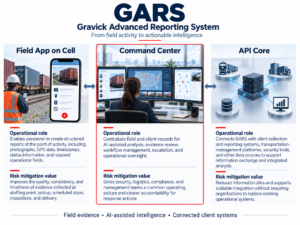
Gravick Group addresses this challenge through GARS, the Gravick Advanced Reporting System, a modular operational platform designed to capture, secure, route, review, and analyze operational information in a unified environment. GARS connects verified field activity with records from clients’ existing collection and reporting systems, bringing them together in its Command Center for AI-assisted deep analysis. This supports real-time decision processes, giving security, logistics, compliance, and management teams a clearer view of risk and greater accountability for response.
The Command Center combines operational oversight with AI-powered supply chain intelligence. Teams can administer field reporting, review evidence, and coordinate responses while accessing relevant information from connected client systems through the GARS API Core. Integrated AI capabilities enable users to ask questions in plain language, perform link analysis and correlation across records, and analyze documents, images, audio, and video—including footage from fixed cameras and drones—to help identify relevant activity and support incident review.
Social listening across sources such as X and accessible Telegram channels can help corroborate client and GARS reports, add context to operational events, and surface emerging threats. Automated monitoring flags information that matches defined risk indicators, while source-linked summaries help teams assess findings and prioritize action. Access permissions and review workflows keep information and response decisions under authorized control.
THE GARS PLATFORM
Summary of how the GARS platform supports risk mitigation:
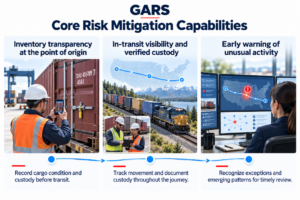
Core Risk Mitigation Capabilities
Inventory Transparency at the Point of Origin
Before a shipment enters transit, GARS can create a structured record at the loading point that includes time, location, personnel, goods documentation, photographs, and custody details. Standard required fields, timestamped submissions, GPS tagging, and supporting evidence reduce ambiguity in the event of a shortage claim, damage dispute, customs inquiry, seal discrepancy, or suspected theft.
Reliable documentation supports investigations, insurance claims, and the defense of an organization’s actions.
CUSTODY AND EARLY WARNING
In-Transit Visibility and Verified Custody
Traditional tracking systems are useful, but location data alone does not establish whether a shipment remained under appropriate control. GARS can document:
- Confirmed pickup location and time
- Scheduled stops and required checkpoints
- Evidence of custody transfers or operational handoffs
- Arrival and delivery confirmation at the final destination
- Supporting evidence
Early Warning of Unusual Activity
GARS enables organizations to define escalation rules based on their own risk tolerance, cargo profile, geography, customer requirements, and operating procedures. AI-assisted analysis can help distinguish routine operational variation from patterns that warrant escalation or investigation. Predictive analysis can further help teams anticipate potential delays, disruptions, or elevated cargo risk by assessing historical patterns alongside current operating conditions. The system can route information to the appropriate teams based on event type, location, severity, or client-defined criteria. Final response decisions always remain with authorized personnel.
The most valuable risk controls identify exceptions early enough to allow a proportionate response. Key alert categories include:
- Unscheduled stops or extended dwell time
- Route deviations from approved transit plans
- Real-time notification of seal violations or integrity concerns
- Missing, late, or incomplete required field reports
- Repeated exceptions associated with specific corridors, facilities, carriers, or operating conditions
OPERATIONAL OUTCOMES
Earlier risk detection. Faster incident review. Better-informed decisions.
GARS combines field capture, evidence management, geospatial context, workflow automation, and system integration in one configurable platform. AI-assisted link analysis can connect the dots between seemingly unrelated activities—for example, identifying shared locations, carriers, or custody handoffs across separate incidents that may indicate a broader pattern of risk. Together, these capabilities can help establish a more reliable operational record, improve the speed and consistency of exception review, and give leadership clearer visibility into transportation and cargo risk.
Performance can be assessed through report completion rates, completeness of custody documentation, time from exception reporting to review, recurring exception trends, and investigation resolution time.
Through the Gravick Advanced Reporting System, organizations can connect verified field activity with operational and executive decision-making. By improving inventory transparency, strengthening in-transit visibility, and helping teams identify unusual activity earlier, GARS supports a more disciplined and auditable approach to supply chain risk mitigation.
Connect Field Intelligence with Your Risk Strategy
Contact Gravick Group to discuss how GARS can support your supply chain reporting, intelligence, and risk mitigation needs.
Gravick Group partners with organizations to identify vulnerabilities across global supply chains and develop practical, scalable risk mitigation strategies. By combining subject matter expertise, proven operational processes, and advanced technology, Gravick Group helps clients build resilient supply chains that anticipate evolving threats while protecting people, products, and profitability.
Gravick Group
info@gravick.com | +1 (866) 518-0608